Showing posts with label travel. Show all posts

Friday, March 25, 2011

Anti-HS2 Campaigners Can't Get To Anywhere To Protest

Campaigners trying to save the pristine, virgin countryside they say is threatened by proposals for a new High Speed line from Birmingham to London have run into an obstacle due to their principled stance against countryside damage and compulsory purchases.

“We were going to go down to that there London, but it turns out it isn't at the end of our road,” explained campaigner Hillary Billingsworth, 35. “In fact London isn't even in our lovely, picturesque village, with its robust house prices.”

The campaigners are concerned that the area around the Chilterns, which has lain untouched for hundreds of years after all the forests where cut down for farms and to build the Elizabethan royal navy, may have its character permanently altered by having trains run through it periodically.

“This land has been just like it is now since I was born and, therefore, must always have been like this and, therefore, must always remain like this,” said Billingsworth. “Apparently some of these so-called trains make noise, whatever that is, and we simply can't have any ducks in the area inconvenienced by periodically not being able to hear a frog.”

The obstacle to increased protests is that there is no mechanism by which the campaigners can go anywhere where there heartfelt pleas on behalf of the wolves and bears that where displaced by the clear-cutting of the forests in the middle ages can be heard.

“Well, I worked out where London is, but just as I was about to buy a train ticket one of our members pointed out that the Great Western train line had in fact been built through countryside 150 years ago,” said Billingsworth. “It was a great shock to us all I can tell you.”

The group's revised plans, to take a rail replacement coach trip to Parliament Square, were then thrown into disarray by another member who had recently borrowed a book on transport from their local library, which has since closed.

“Well, Brian said that the motorway was only built in the 1960s and that previously it had all been countryside,” said Billingsworth. “It turns out it is countryside under all the roads, and people's houses were demolished to build some of the bridges. It is very alarming.”

The campaigners have finally solved the transport problem, although they do admit that the revised travel plans will make their journey times somewhat longer as they plan to walk to Birmingham airport and then fly to London.

“We remembered what a good job it was that Mother Nature made all those natural tarmac runways for us to land planes on when we visit charming, unspoilt villages in Tuscany! Mind you a two-day trek across the hills to Birmingham will be a bit of a palaver,” said Billingsworth. “If only there was some other way to get from Birmingham to London quickly.”

Wednesday, January 12, 2011

Tube “drivers” Announce Plans To Strike In The Face Anyone Seen Smiling In London

ASLEF, the union that represents a broad spectrum of London Underground employees who spend all day sitting and pushing a button, have announced that its members have voted to strike anyone found in London on their day off squarely in the face.

“Our members, who sit in the train cab and push the button to close the doors and instruct the train to drive itself to the next station, cannot risk being distracted by people smiling in London. This normally isn't a problem – who does smile on the Tube anyway?” said Keith Billingsworth, a representative of the supposed Train Drivers. “But they might smile on a day off, like a Bank Holiday. The smiling happy bastards. And our London Transport staff simply can't cope with that and will of course strike.”

ASLEF has said that the immediate reaction of any Transport for London staff member, when faced with a commuter with a smile on their face, would be forced to punch them sharply on the nose.

“Now, if our members are not to have to give up the opportunity of punching their passengers then they need to be compensated by receiving triple pay and a day off to recover from seeing an unpunched smile,” said Billingsworth. “They also need the day off to count all their cash.”

ASLEF was quick to point out that it wasn't a purely financial decision that has compelled them to threaten to resort to customer-striking unless they received quadruple benefits for working one day, it was the heavy burden of responsibility that they deal with on a daily basis.

“The person driving the train is probably one of the highest paid people on it, earning more than you because, unlike you and the pathetic reason you are on the train, he has a very important job to do,” extolled Billingsworth. “The Senior Train Drivers press two buttons – the one that makes the computer drive the train and the one that swaps the set of automated announcements to 'Tourist Mode' which tells people where the landmarks are. That is two buttons for a starting salary of barely over £40k. You compare that to your job - it really is a smack in the face.”

Thursday, January 06, 2011

Motorists Welcome Moves To Scrap Confusing Road Signs And Anything Else That Might Slow Them In Getting Home To See Corrie

As society continues its inexorable slide to removing any need for anybody to learn anything, ever, the government acquiesced to demands from people who filled in an online petition from their wrecked cars and promised to review and scrap any road sign that was not immediately understandable to either a 5 year old child or a common-sense using Daily Mail reader.

“It is simply not my responsibility to understand stupid road-signs, who on earth knows what 'Give Way' means anyway?” said Sophie Billingsworth. “All I want is a straight road to my house with no distractions. Having to take care at junctions sometimes makes me miss the start of Emmerdale. It's so unfair.”

However Twitter feeds and Facebook pages, the true measures of all matters of import in 2011, have been full of debate, with those both for and against the changes offering reasoned arguments in support of their position.

“Stupid signs, having to read them distracts me from texting what I had for lunch,” said @Crasher1981. Whereas another user commented that “If the road-signs did not tell me, how would I know what speed was safe to drive at? Especially at night, on unlit roads. In the snow. Whilst texting.”

Motoring organisations say that it is often signs that cause so-called 'Information Overload' which can lead to accidents, especially at busy junctions or if Gail McIntyre (née Potter; previously Tilsley, Platt and Hillman) has decided to marry yet another person from the same street.

“These signs are so boring, sure they may provide information but what use is that to anyone? Anyway common-sense says that I can either read a stupid sign or a tweet about Tracey Barlow, but not both,” said Billingsworth. “I have been driving for over 20 years and never had an accident – mind you I have seen plenty in my rear-view mirror.”

Saturday, April 24, 2010

Fury As Icelandic Volcano Receives Payout

Following over a week of flight chaos caused by a huge cloud of ash from the erupting Eyjafjallajokull volcano there has been outrage at the settlement agreed with the enraged Icelandic resident, who many believe has held the European travelling public and airline industries to ransom.

“Forcing airlines to stop flying until your demands are reached? It's been extortion, pure and simple,” said Duncan Billingsworth of the Unite union. “That's our trick. Although hats off to that cloud of ash, we only managed to ground British Airways, not all airlines.”

The Volcano is believed to have been bought off by airlines that realised that unlike a normal weather system, a Volcano may be able to keep its disruption up for decades, forcing many airlines out of business. Some carriers have had to run disrupted flight plans on increasingly convoluted routes through Spain in a desperate attempt to get passengers to their destinations, and avoid paying expensive hotel bills.

“We have been forced to land a lot of our flights to Germany at airports in Madrid,” said a spokesman for Ryanair. “This has of course caused some disruption for Ryanair passengers trying to get to Germany as Spain is closer than we normally fly them.”

Airline manufacturers and operators across the globe have gained more information and understanding of the impact of volcanic ash on aero-engines. This has led to the re-opening of European airspace and the gradual re-uniting of thousands of whining passengers stranded overseas with their moaning families back in the UK.

“Meteorologists and volcanologists are undecided as to exactly when the skies of Britain will finally be free from the gloom of this overbearing cloud damaging the economy,” said one satirist. “Gordon Brown will be leaving office on May 6th, but the ash may linger for longer.”

Iceland has declined to comment on suspicions that following a year of economic turmoil, during which the entire country was effectively bankrupt, owing billions to international creditors, it raised some suspicions when the north Atlantic island was set on fire. Insurance experts will be scrutinising any insurance claims carefully.

Max Clifford has said that his new client, the Eyjafjallajokull volcano, will reveal the full details of its explosive blow-up in a forthcoming exclusive interview with Heat magazine.

Thursday, February 18, 2010

New autobiography is a catalogue of near misses with disaster “Only 3673 miles from death”

A new book published today chronicles the astonishing life of Herbert Billingsworth, 88. It is a story of good decisions, fortuitous coincidences and blind luck that has enabled Herbert to consistently cheat death and catastrophe. Reproduced here, exclusively, are a few extracts from Herbert's amazing tale of near misses in his memoir entitled “Only 3673 miles from death.”:-

11th September 1921
I was born in Preston in Lancashire on this day. The son of a Scottish merchant seaman and the Eskimo girl he won in a poker tournament in Newfoundland, I was brought up to understand the hard life of the inter-war mill towns. Fortunately this meant I was not born in the USA as the son of a man who went on to be the anti-semetic US ambassador to wartime Britain. Whilst it was a shame I never had the chance to go to an Ivy League college in the USA, it also meant that I was never able to run for US President. Thus it was by sheer chance that I was not sitting in my open-top limousine waving at the crowds in Dealey Plaza, in the heart of Dallas, on the 22nd November 1963. You can imagine my relief that it was not me assassinated that day, but it could have been very different.

6th June 1944
As a 22 year old apprentice working on the London Midland Scottish Railway I was in one of the reserved professions. We worked hard, I tell you, running the steam trains longer and faster, working on them day and night as a key part of Britain's war effort that had spent years under constant bombardment by the Luftwaffe until the RAF gained air supremacy. But for that choice 6 years earlier this glorious summer's morning when I was cooking us a well earned fry-up with our combined egg ration on the boiler plate of “Old Gerty”, could so easily have been different for me. What with me maybe having my limbs blown off on the beaches of Normandy.

30thJuly 1966
On this day it would not even have been three years since I narrowly avoided being shot in Dallas. It shocked me to realise that but for having no interest in football a mere three decades earlier and having taken up boxing (I was pre-war LMS under 16 champion) it could so easily have been me dancing with the Jules Rimet trophy on that marvellous day in Wembley. And not Nobby Styles. And I would have had no teeth.

9th May 1976
I have never been into all that queer sex malarky. A quick doing with the missus, with the lights out, after Match Of The Day is as kinky as I ever liked it, thank-you-very-much. But it makes me think on that it is only my red-blooded heterosexuality, never having been to London and with a keen lack of interest in politics that meant that it was Jeremy Thorpe who suffered the male model bum-sex scandal. I admit I did shag his dog on Exmoor though.

11th September 2001
My granddaughter had talked about doing something special for my 80th birthday. She suggested maybe a holiday in America and a trip on the transcontinental railway. Whilst it is one of the great train journeys of the world, I really do hate Americans and I hate heights and flying, so I never entertained the idea of going there or to somewhere so full of tall buildings as New York. I don't even have a valid passport. So you can imagine my horror when I discovered that New York's World Trade Center towers had been the victim of a terrorist outrage and brought crashing down. They contained the “Windows of the World” restaurant I had absolutely no intention or chance of ever being in. It just brought home to me how that simply could never have been me,

“Hecker's like, and that's swearing, I never miss a domino's night in the Dog and Spade now,” said Mr Billingsworth, speaking at book signing. “It shakes me to the bone to realise that sometimes I have cheated death by just a matter of months or a scant several thousand miles, but then I guess I am just lucky.”

Realising he was in some way charmed, having escaped misfortune so often in his 88 years, had emboldened Herbert to embark on a new travel book entitled “A Wintry Descent Of The Alps By Toyota Prius.”


Tuesday, January 19, 2010

As the 25th anniversary passes we try to remember life before the Sinclair C5

A quarter of a century may not seem like a long time, but like the mobile phone, or the internet, it is difficult to imagine exactly how we lived before our towns were filled with the distinctive whine of straining electric motors or the hillsides strewn with panting red-faced drivers that so characterise the environment in the post-C5 era.

25 years ago this week the streets of the UK, and the world, were completely free of Sinclair C5s. Pavements outside coffee shops, libraries and intensive-care units at hospitals were not lined with rows of scattered and crushed electric tricycles, plugged into pay-as-you-go electricity points.

“It really is one of those inventions, where you think ‘How did we get by before it?’ and wonder why hadn't it been invented sooner?,” said Professor J. Scott Billlingsworth. “Being below tyre height with a juggernaut and having even less protection than a bicycle makes you feel so alive. Albeit briefly.”

Research has shown that most people, not just those born in the last quarter of a century - the so-called “C5ers” - cannot remember a time without Sinclair's ubiquitous marketing slogan “You never feel as popular as when you wake up with a crowd around you.”

Professor Billingsworth has studied the effect that the C5 has had on our culture, behaviour and the industries that have sprung up around it.

“You probably don’t remember when all drive-through take away places had the speakers and counters at stomach height? Now, because of the C5 they are all at knee height. Yet few people understand why,” said the Professor.

Professor Billingsworth’s research has documented testimonies from ten of thousands of people recalling their experiences with the C5 and how it has changed their lives.

“People tell us how they were liberated by the freedom the C5 allowed them,” said Billingsworth. “A freedom to explore anywhere within a 10 mile radius. As long as the weather is good, and there is no traffic. And the road is very flat.”

In our C5-centric society it is also difficult to remember a time before drive-in cinemas where young, panting couples can park near each other and recover from the exertion of overcoming the ramp into the car park. Wearing only their winter thermals and duffel coats they happily spend a romantic evening shouting sweet nothings through scarves and earmuffs across the gap between vehicles.

“We all have our own stories - of couples whose batteries run out 3 miles from home on dark, deserted lanes,” mused Billingsworth. “Who doesn’t remember the first time they had sex in a C5?”

Sunday, February 08, 2009

Teenagers complain of anti-social pensioners reading aloud

Teenagers up and down the country are bemoaning a new fad of reading out loud that seems to be sweeping through the senior citizen population. With half-term approaching it is feared that this behaviour could drive more and more teenagers from the buses and force them to walk all the way to the nearest Gregg’s pasty shop.

"It’s, like, so, like, rude. Innit?" said Chardonnay, 14 from Plumstead in South London. "We is like on the 96, right? Few of us girls. Innit? And we are trying to listen to Shabney’s music. She got the volume right up on her phone but we don’t hear, like, nothin’ ‘cos of, like, some old dear at the, back, reading aloud some rubbish about a bitches’ Detective Agency in Africa."

The phenomena is seen to be the latest step in anti-social behaviour on public transport and something else that delay-weary passengers must contend with.

"It really is quite terrible now," said one middle-aged commuter who didn’t want to be named

"When I have sloped off work early I often have to share my train with old and young people alike. A couple of years ago we would be whizzing through the country listening to the tinny screeching of Chris Brown, or Rhianna, from a mobile phone. Now it’s all people reading sections from ‘Captain Correlli’s Mandolin’ and bits from discarded copies of the Metro at the tops of their voices."

Many commuters find that middle-aged people have taken to the habit of playing audio books through their speakerphones.

"It’s like sitting in Stephen Fry’s living room sometimes," said a commuter. "I have to bring a dictionary with me now just to know if something is rude."

However some of the teenagers said that the disruption caused by older members of society wasn’t all bad as it gave them a rare insight into literature, something that would otherwise be unattainable to them.

"No one at my home can read nothing. Apart from maybe text messages, right?" said Derrington, 15 from Kidbrooke. "Although if one is totally honest one would prefer less about ‘Come Dancing’ and more contemporary cultural references and insights into the human condition. Like."


Friday, January 16, 2009

Heathrow plans new 3rd runway on the River Thames

Planning agreement has been reached for a new third runway for Heathrow airport and, in a surprise compromise with campaigners to protect the nearby village of Sipson, the new runway will be laid out in the waters of the River Thames.

"Following recent trials with an Airbus A320 in New York’s Hudson River, we are pleased to announce the location of Heathrow’s third runway will extend westwards from the Isle of Dogs," explained BAA spokesman Gregory Billingsworth. "The planes will be able to drift to the new arrival gates at either Greenwich or London Bridge, depending on the tide."

However the plan has already met with protests from celebrities who have new movies to promote.

"I am trying to buy a piece of the river under Tower Bridge to try to save the historic water from having a large plane splash onto it," said a dishevelled Emma Thompson who had just finished walking from Los Angeles to London. "It is madness - the damage that will be done to the pristine, natural environment of London by introducing a third runway and also what will I look like in the tabloids, my hair goes all frizzy when it is wet and yellow lifejackets just aren’t my colour."

BAA said the planned river runway showed the airport’s continued desire to be part of Britain’s world class integrated transport network.

"How much more integrated do you want? There is a regular clipper service running up the river which connects with train services," said Billingsworth. "Sure your luggage may be returned to you soaking wet and covered in silt and any fish in your cases will have to come out of your baggage allowance, but it is a huge improvement upon Terminal 3."

Sunday, October 05, 2008

Are Sat-Nav systems starting to behave like their celebrity voices?

With the prolific adoption of in-car satellite navigation systems that offer more and more functionality, many owners are customising theirs using celebrity voices in place of the normal mid-Atlantic sounding female voice. Reports from motorists are now starting to be collated and reveal a worrying trend that the systems are taking on the characteristic behaviour of the celebrities they sound like.

"Initially we received reports about the Mr T voiced Sat-Navs." said Austin Billingsworth of the RAC. "Several people have said that when they try to program them for journeys to an airport the devices refuse to plan a route and instead only respond with ‘I ain't gittin' on no plane, fool!’"

Initially thought to be a mohawk-wearing celebrity problem, the RAC has also received hundreds of reports from all over the country from people who use a variety of celebrity voices to spice up long journeys.

"Several users have reported that updating their systems to use the voice of George Michael has left any journey through London causing the system to become horribly confused around the area of Hampstead Heath," said Mr Billingsworth.

The RAC says that other drivers in London have reported that David Pleat voiced Sat-Navs repeatedly urge the motorist to slow down if they attempt to travel over 5mph in red-light districts.

"Many people still prefer a female voice giving them instructions," said Billingsworth. "But those that have installed Gillian Taylforth find that they are constantly being directed to roadside lay-bys for frequent rests, and that they should perhaps undo their trousers to be more comfortable."

Motoring organisations have stated that drivers should be wary of any unexpected commands from James Dean Sat-Navs and young women should be extremely wary of receiving a lift from anyone whose device is voiced by Edward Kennedy.

Wednesday, August 27, 2008

Ryanair to charge passengers for in-flight oxygen

Budget airline Ryanair has today launched the latest innovation in the low-cost airline industry with the announcement that passengers will be asked to purchase the amount of oxygen they wish to breathe during their flight as part of the check-in process. During the flight passengers will then be able breathe their allotment through masks that will be hang form the overhead compartments.

"With rising fuel prices Ryanair is once again demonstrating innovation in keeping costs down for passengers, " said Chief Executive Michael O'Leary holding a press conference whilst wearing an aqualung to demonstrate the frequent flyer option. "We are continuing to make air travel affordable to gasping, blue-faced Europeans."

The plan was announced on Tuesday following a successful trial of the ‘Pay as you Go’ option during one of the airline’s flights on the Bristol to Barcelona route. All passengers who were offered the chance to breathe at high altitude said that it was a service they were very interested in, some were even seen shedding tears of joy during the trial.

During the new check-in procedure passengers will be asked a series of questions to help them purchase the correct amount of Oxygen, such as:

Which of the following in-flight hallucinations do you
require?

  1. Pink Elephants
  2. Elvis dancing with Princess Di
  3. England qualifying for the next World Cup
When you reach your destination do you wish to be alive?
People who wish to book tickets on the new OptionAir flights should be aware that if they bring their own oxygen in the form of party balloons or compressed air tanks these will need to be checked into the hold at extra charge.

The flight was also another landmark for Ryanair with it's notorious policy of rebranding small regional airports with the name of a more sought-after destination city that may in fact be many miles away.

"We are pleased to announce the introduction of services to Barcelona Limoges airport in central France," said Mr O'Leary. "Limoges offers travellers the opportunity to visit the heart of rural France and sample transcontinental rail travel and an overnight stay on their trip to one of Spain's leading cities. This makes it by far the most convenient of Ryanair’s direct flights."

Wednesday, January 23, 2008

Latte-Nav systems provide emergency Starbucks locations

A new range of satellite navigation systems has been launched which are capable of providing car drivers with directions to their nearest Starbucks coffee shop as well as optional directions for non-coffee purposes and data about traffic jams, speed-cameras and accident black spots.

"Today it is more important than ever that motorists have the security of knowing where their nearest opportunity for some overpriced frothy milk is," said Austin Billingsworth of the RAC.

The new systems also integrate into a car's vehicle management system to provide emergency warnings in the event that the driver has not stopped for the suggested 15 minutes and had a caramel-Macchiato with cream every three hours of driving. It will also sound an alarm if the amount of fuel remaining is insufficient to get the driver to the nearest Starbucks, warning if the only coffee available is from a petrol station vending machine.

"We think this service will help cut down on road rage incidents," said Mr Billingsworth. "Studies show that most random direction changing is caused by female shoppers running low on caffeine. Mind you they do that out of their cars too."

The new systems have only recently become possible because of the availability of ultra-high resolution GPS data from upgraded direction finding software.

"Traditional GPS systems are accurate to about ten metres," said Billingsworth. "This may be good enough to land a plane, or aim an intercontinental ballistic missile, but it would never be good enough to distinguish between each Starbucks in an average town."

Rival systems are soon to be made available. A consortium led by Café Nero and Coffee Republic are believed to be investing heavily in Europe's replacement global positioning system, Galileo, while last week saw the latest Chinese rocket launch carrying the first of the Costa Coffee satellites into orbit.

Monday, December 24, 2007

Chaos over Christmas due to faulty navigation systems

This Christmas has seen a record number of complaints from households the length and breadth of the country due to a batch of faulty 'ChatNav' systems.

“Christmas and New Year are a time when millions of people travel across the country to be with loved ones,” said Professor J. Scott Billingsworth. “When we get to our destination we are tired and facing another few hours of tricky navigation through a minefield of conversation subjects and it seems the 'Chat Navigation' systems that we have come to rely on have let us down.”

The festive season is a always a notoriously difficult time as families get together for possibly the only time of the year. Many people struggle to navigate the tricky path through family history whilst avoiding known incident blackspots at frosty receptions which may involve long journeys across thin ice.

“Of course at Christmas the problem will have been exacerbated by alcohol,” said the Professor. “This can cause people to drive headlong into areas that are best avoided. Indeed Christmas drinking can engender a desire to get to the point as fast as possible and can cause reckless behaviour and lead to the one driving the conversation to misread even the most unmistakeable of warning signs.”

Our increasing reliance on technology such as ChatNavs means that without the systems many people are helpless. Men in particular are notorious for refusing to accept help when driving a conversation in a completely inappropriate direction oblivious to any suggestion from wives and girlfriends keen to avoid any looming obstacles.

It is believed that the problems with the latest generation of ChatNavs were caused by a failure with the worldwide GPS – Grievance Prevention System - although the approaches taken by previous generations are frequently routed through treacherous territory.

“We have known for some time that many 'chatnav' systems used by older family members can lead to huge meandering diversions down memory lane,” said Professor Billingsworth. “Some of these can lead to many extra hours of pointless meanderings culminating in blow-ups on the way home.”

Wednesday, August 15, 2007

Nation's last “left lane” driver retires his Hillman Imp

The last driver known to conform to good lane discipline on Britain’s motorways today announced, on his 75th birthday, that he was to hang up his driving gloves.

"I have been driving for over 55 years and recently have happily travelled everywhere in my little 1966 Mk II British Racing Green Hillman Imp," said Harry Woods, speaking to BBC Radio. "However the time has come for me to call it a day. I am not as young as I was."

The news was greeted with mixed reactions as a great many people lamented the inevitability of the human condition and car enthusiasts mourned one less roadworthy classic in daily use.

"It might not be capable of more than 50 mph, but it is reliable, come rain or shine," said Harry. "I don't like motorway driving – in fact I only use the short stretch between junctions 9 and 10 of the M25 - about six miles - so it doesn't bother me that I can't get out of the left hand lane."

However Francis Billingsworth, from Thurrock in Essex, said that she was unmoved as to the impact this announcement would have on her life. Francis, who drives a 2003 Ford Focus explained that it was people such as Harry that were the cause of her predilection for the middle lane of the motorway.

"I think I had to change lanes to overtake a green car on the M25 a couple of years ago. I haven't been in the slow lane since." explained Mrs Billingsworth. "I heard Harry's interview on the radio as I drove to see my daughter in Cobham. Well you know I turn off at Junction 10. So I got straight into the middle lane when I got on the M25 - about 40 miles early - just in case."

The RAC said today that as far as they are aware, Harry and his classic car represent a dying breed of motorist.

"It is the old traditions that are dying out," said a spokesman. "The classic car, the classic colour, and paying due attention to driving standards and proper lane behaviour. It is all from a different era."

Mrs Billingsworth was unrepentant, however, claiming that her motorway driving technique, of remaining steadfastly in the middle lane regardless of road conditions, was the safest approach.

"If I drove how so called experts, like the RAC, say is 'correct', then I might have to change lanes to overtake slower traffic, or perhaps to let lorries and green cars onto the motorway. Well it is difficult enough just keeping to my lane and not hitting the car in front if I am chatting. And before you go saying I am an 'unsafe driver', I should point out that I have been driving for over 30 years and have never had an accident," she said. "Although I have seen plenty in my rearview mirror."

Monday, June 25, 2007

Britain unveils GPS replacement

The Ordnance Survey today revealed its plans to produce a replacement for the ageing Global Positioning System (GPS) in common use for both military and civilian navigation. The new system, seen as a cost-effective alternative to the troubled European Galileo system, has a working title of Pub Orientated Wayfinding (POW).

At the unveiling of the project in the prestigious surroundings of the Grosvenor Hotel, Professor J. Scott Billingsworth said that the system will fit more neatly with true human behaviour than the existing GPS or planned Galileo system.

"When we ask someone for directions, we don’t want a long list involving distances and turns, because we can never remember them." explained controversial behavioural scientist Professor Billingsworth. "The directions that are most successful are those that are related to our easy-to-find local landmarks, such as today as we stand in the Grosvenor, or ‘Just up the road from the Hogshead Pub’ as POW would tell us."

The Professor explained that many people were frustrated that whilst the existing GPS provided clear and concise directions, it does not work very well for providing people with a sense of where they are and provides no help when they do become lost.

"You could be anywhere in the world when the directions are simply ‘turn left in 100 metres’," he said. "So you can’t stop and ask someone directions. However when POW tells you that you need to ‘turn right at the Prince Albert and follow the road then take the next turning left after the Rat and Parrot’ then you know roughly where the Bowling alley is."

The POW team plans to keep their database continually updated to provide ever more granular landmarks that are both useful to the traveller and any locals that he might encounter whilst trying to get to his location.

"When you are lost, if you explain the POW directions to a bystander they will of course know what you mean, unlike current GPS based directions," said the Professor. "The POW database will contain useful waypoints such as a group of kids hanging around outside a nearby McDonalds or the police riot van watching them from the corner."

The POW project has plans for a nation-wide rollout early next year, and is currently evaluating the prospects for international versions.

"The initial launch of the system will cover the UK only," explained Professor J. Scott Billingsworth. "However we may extend the system to less civilised nations, in the event that British ex-pats find enough suitable hostelries for the database."

Wednesday, April 25, 2007

Liverpool’s ‘08 car sharing scheme

Liverpool is currently alive with developments and programmes to celebrate its selection as the European ‘Capital of Culture 2008‘. Today, the City Council unveiled details of its new car-sharing programme to help residents and visitors alike move around the city in a fast, simple and environmentally responsible manner.

“We have always had probably Europe’s most advanced car sharing scheme,” explained Councillor Kenny Billingsworth. “Previously it was a bit more informal. However now we have produced a detailed guide to not only how the system works but also how to get the best out of it on your visit to the city or to one of our many exhibitions.”

The pamphlet entitled ‘Your car, our ride’ contains many hints, tips and maps to local hospitals and solicitors. Advice on the transport initiative includes :-
  • The Car-sharing area is designated by environmentally friendly kerbside markers made of recycled car window chips next to car parking areas
  • Whilst most makes and models are available in the scheme, it is best to choose a car that you feel most likely to be able to drive unobtrusively through the city, especially as some of the scheme’s more modern vehicles have sensitive alarms that can cause first time users embarrassment with local law enforcement officers
  • Should the car not already be open, use one of our handy ‘Remote Unlock Token’ devices found in a nearby builder’s skip
  • It is advisable to wear gloves at all times. There may be broken glass present in the vehicle and the finish of the car is spoiled by fingerprints.
  • Upon reaching your destination do not worry about finding another scheme user to pass a car on to. In the event it is not be needed then it will be dismantled and disposed of by an experienced team of motor vehicle recyclers who operate on a citywide basis. The hubcaps will probably be recycled before you come to rest
  • Liverpool will be a very busy city during the 2008 Year of Culture, so you may find that accommodation is difficult to find. However please do not be tempted to sleep in your car. Not only will this prevent it from being available to other scheme members but you may suffer frustration if you wake up to find the vehicle has come to the end of its life and is being burnt out.

Saturday, April 07, 2007

Britons “pleased to see ex-pats go”

A new study released today claims that most Britons are pleased when ex-pats leave their native land and head to far off countries.

“It appears these ‘wannabe ex-pats’ have been getting on the nerves of other people in Britain so when they announce they are going to leave, most people wish them well and hope it will be soon,” explained Professor J. Scott Billingsworth.

The survey polled thousands of homes from up and down the land with consistent themes recurring throughout.

“Oh yeah, our neighbours used to constantly moan about Britain, the weather, the trains, young people, the television, the traffic,” explained Arthur MacAulay, from Falkirk, who took part in the survey. “Everyday it would be something new that they didn’t like. I was so pleased when they said they were leaving for Paxos, I offered to drive them to the airport.”

Mr MacAulay’s feelings were echoed by Martin Edenbridge from Aynsford in Kent. “The people next door? Oh they showed no interest in making anything better – never contributed to the parish council, never spoke up on planning issues, but just moaned endlessly. Bizarrely they went on and on about the schools, but they didn’t even have any kids,” he said. “Mind you, what can you expect, it took them 43 years to find the airport!”

The research revealed that most ex-pats still obsess about the country they left behind even though they only keep in touch through tabloid media.

“We collated the comments posted on the websites of the major newspapers - as well as the Daily Express and Daily Mail. We also checked the viewer's comments on 24 hour news channels.” said Professor Billingsworth. “Invariably there will be a comment from someone who left a decade ago but is using the current headline as a platform to both justify their decision and rubbish Britain.”

The research found that these constant justifications get wearing for those back home hearing about how a third-world country is actually an undiscovered paradise, an experience shared by Mr MacAulay.

“We got a few phone calls after they left going on about how great it was. Last time he was almost hysterical,” explained Mr MacAulay. “He was raving about how none of the locals spoke English, the only Doctor was at the top of a steep mountain path, they didn’t have running drinking water and the rustic supermarket was hardly open. Of course what really grated was when he patronisingly assumed I would want to join him. ‘Please call for help’ he said!”

Monday, April 02, 2007

London buses concern over Iran

The escalating crisis between Iran and the United Kingdom over the detention of 15 British service personnel has aroused concern not just throughout the political and military worlds, but also for the Bus planners of London Transport.

“From what we have learned about the crisis, from the media, both countries are in dispute over the position of boats using GPS,” explained Ken Billingsworth, Manager for Bus Logistics Central London. “We use the same system to track our buses, so if it doesn’t work it could be a disaster.”

Transport for London uses GPS to locate its buses for amongst other reasons populating the electronic displays on stops that give the expected time of arrival of the next service. There have long been questions and complaints regarding the displays. Many a commuter has looked down from the sign saying their bus was due to find an empty road extending into distance.

“I mean GPS systems are supposed to be accurate to within a few metres. Yet the dispute is over miles. If they were really that inaccurate, it would be chaos. Those electronic displays could be showing any old rubbish,” explained Mr Billingsworth. “We may as well just scroll through the timetable and not bother tracking the actual buses.”


Splash Nav


In related news Belinda Willis, who famously wrote off a £96k Mercedes in a river following the instructions of her satellite navigation system, said she felt vindicated by the crisis.

“If sailors can get into troubled water following GPS, what hope has a motorist?”

Wednesday, March 28, 2007

Spy reveals MI6 economy drive

Speaking from an undisclosed location, a British secret agent, has launched a stinging attack on the UK’s mysterious espionage masters. The agent, who revealed himself as “Deux Blow Sven” said that he was frustrated by the new policies which he said were being driven by government budget cuts and environmental concerns.

“Many people think it is all a life of fast cars, yachts, and expensive hotels,” he said. “Those days are long gone and, frankly it is starting to affect the way we operate.”

‘Sven’ revealed that as part of his recent investigations he had been required to travel from London to Frankfurt, to follow the trail of a master-criminal planning on holding the GPS system to ransom.

“Well it was all a bit more stressful than in the past. Previously I would just turn up at the airport smelling of the perfume of last night’s conquest covered in the blood of my last victim,” he reminisced. “This time I had to have an early night because of the need to get the first off-peak Stansted Express, “said an exasperated agent. “Then I found out that my tickets were booked on Ryan Air. I carry a lot of … er … specialised equipment, so this took some sorting out.”

Whilst his suspect had flown into Frankfurt’s main airport, ‘Deux Blow Sven‘, on Ryan Air landed in Frankfurt Hahn airport.

“Yes, that was a problem, my tracking devices that I had planted in his suitcase, only have a range of 50 km, nowhere close enough to a city for a Ryan Air flight,” explained the agent. “Of course having to take the bus into Frankfurt to my Travelodge added another couple of hours.”

‘Deux Blow Sven’ had given up all hope of tracking down the Super-villain until a chance meeting at a cybercafé in the city centre put him back on the trail.

“Yes, we had a laugh about it. Before I killed him!” smiled the British Spy. “It turned out SMERSH has implemented a sophisticated, but bureaucratic, carbon offsetting system and my target was having a nightmare calculating the emissions from his stolen Arianne space rockets.”

Friday, December 22, 2006

Desperation at UK airports

Most UK airports were filled with desperate news reporters tryng to turn the recent bout of fog into screaming and tearful human interest stories.

"I have tried everything," said Katrina Billingsworth, in between live reports from Heathrow for 24 hour news channels. "The truth is it looks like the airlines have handled it well and people are being quite sensible. Its a disgrace."

"The airports need to give each plane more space on the ground," explained Ms Billingsworth. "Cancelling domestic flights gives them the space for the international flights and only effects those people who could get a train or bus or something else".

"I tried in one report to make this sound like 'So those on their expensive luxury holidays are looked after, but people just trying to visit relatives for Christmas aren't being allowed to do that', but it just came across as ridiculous on air as it sounds here."

An emotional Ms Billingsworth fought back the tears "Damn Britain for being a bloody island and having various means of transport. I mean it all makes sense and is so unfair. The bloody fog has come a few days too early to really impact Christmas. And if it does carry on well no one will be interested. Does no one care about my Christmas?"

"One family had a connecting flight cancelled, and they were going on about their Christmas presents being in the luggage, that sounded promising - I was sure I could get the kids to cry, but it turned out that their suitcases were just waiting at a different terminal in the same airport. They just don't care about us ordinary reporters. They don't care about my news reports being delayed or lost, or my promotion being cancelled."

Ms Billingsworth's mood cheered when it became apparent that BA's website was struggling to cope with the load of enquiries and there were also delays in answering the emergency helpline.
"Shame it was only the website that crashed, but this could still be great. I just need to get someone to burst into tears at the Internet cafe, hopefully who has an ill grand mother, and it might be a good Christmas after all. "

Thursday, December 14, 2006

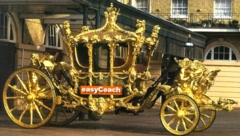
easyBus to expand into long haul with easyCoach

Today, the airport shuttle service arm of the easy Group of companies announced its long awaited plans to expand into the national “long haul” bus market by adding two newer, larger vehicles to its fleet and the launch of its new easyCoach brand.

“Several years ago we vowed to take on Megabus in the low-cost, no-frills inter-city coach business, however the major issue was finding the right vehicles to compete,” explained Fiona Billingsworth, CEO of easyCoach. “Our current Mercedes Sprinter minibuses are not suitable for the London to Glasgow run, however we have now done a landmark deal in coach leasing to bring easyCoach to the market.”

The new fleet of vehicles has been leased from the House of Windsor and the Lord Mayor of London. Whilst easyCoach admits the vehicles are old, nearly 250 years old in fact, they have been regularly serviced and are in ‘showroom quality‘ as they have only been used once a year.
“Our customers come to us for value for money and so they will welcome the new coaches. We think our customers will love them, even though they are a bit brighter and more gaudy than the easy Group’s normal and more reserved orange styling.

“Since we have two coaches in the fleet we can give customers used to easyJet the reassurance that we have a backup in the event a service has to be cancelled.”

Ticket pricing has yet to be finalised, however easyCoach said that they would be competitive in the market. “Yes, we won’t be beaten on price. However book early because there are only four seats in each coach but we are sure we can cram quite a few passengers in!” said Mrs Billingsworth. “Journey times too will be competitive depending on how often we stop to give the horses a rest - we currently plan for a monthly service, with each journey taking approximately a fortnight in either direction from London to Glasgow. Which competes favourably with how long a journey on Virgin Trains feels.”

Trump vs Salt Bae